While I have shared one or two ghost stories with you before on this blog, what follows is true and concerns a different type of haunting.
The clinic was not quite what I was expecting – a Victorian redbrick villa painted fondant pink, with a cluttered porch and dark hallway. The blue plaque was a relatively recent addition, the therapist explained as she led me into her consultation room.
She left me to get ready and, as I eased myself onto the thin sheet of paper covering the black plastic couch, I glanced around. On the walls, large charts mapped the body’s meridians in complex networks of coloured lines. A life-sized skeleton dangled from a stand. In the bay window stood a hefty wooden desk. It would have made a fine room for writing; before the trees grew so tall, you could have sat and watched the river flow by below. It’s a beautiful stretch, with reeds and yellow water-lilies. Sometimes, you can spot kingfishers – darts of blue and blurs of red so quick that by the time you know what you are seeing, they’re gone.
Once the therapist had returned and set about the treatment, tweaking fine needles into place, she left me alone again for a short while, and I thought of the man who’d lived in this house some 130 years ago; how perhaps he’d sat at his own desk by that window and gazed out while he wrote one of his novels. When I’d booked the appointment, I’d had no idea that Thomas Hardy had made this building his home, and I wondered what he’d have thought of it now: his study playing host to strangers in various states of undress, lying there with needles stuck in them like human pincushions. It was a strange notion – the present haunting the past in ways that don’t quite make sense.
I might have witnessed time slip myself once, when I was a little girl on my way to school. It must have been about twenty to nine in the morning. I was walking by myself and as I passed the Angel Hotel, I happened to glance through an open doorway into the hotel foyer. A man dressed in khaki uniform was talking to a woman, and I thought they noticed me. After school, I mentioned to Mum that I hadn’t realised the hotel was reopening, and she told me it wasn’t. The next morning I found the building was still boarded up, as it had been for years.
Is that what hauntings are – folds of time, where the fabric of the present brushes the past? Since then, there have been other experiences that I can’t quite explain, such as waking one night to hear singing at the foot of the bed when nobody was there (I pinched myself to check I wasn’t dreaming) or the rented house that we decided had its own ghost cat.
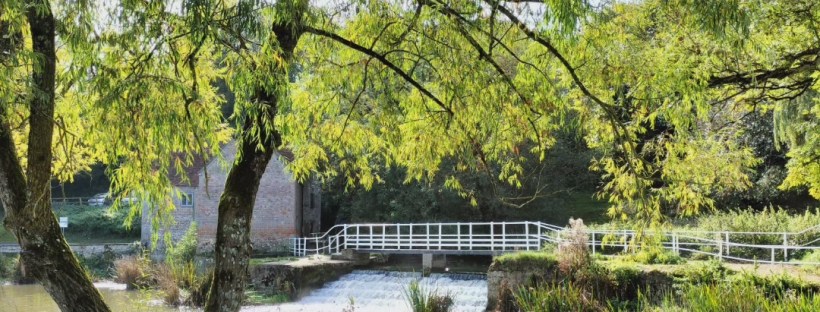
I wonder if it would be possible for Hardy now to catch a glimmer out of the corner of his eye, of forms he can’t quite explain. Perhaps he shakes his head and decides he needs some fresh air. He shouts to Emma that he is going out and strides along the river to the mill, where the wheel clacks and the water tumbles, catching sparkles of light; and where one day, many years later, he will return and write a poem called ‘The Second Visit’, about another type of haunting.

 Sue Belfrage